

The challenge of extreme space environments
- High levels of UV
- Ionizing radiation
- Dryness is one of the main life‐threatening factors since water removal causes membrane phase transition and production of reactive oxygen species that cause lipid peroxidation, protein oxidation and DNA damage, which are lethal to most organisms.
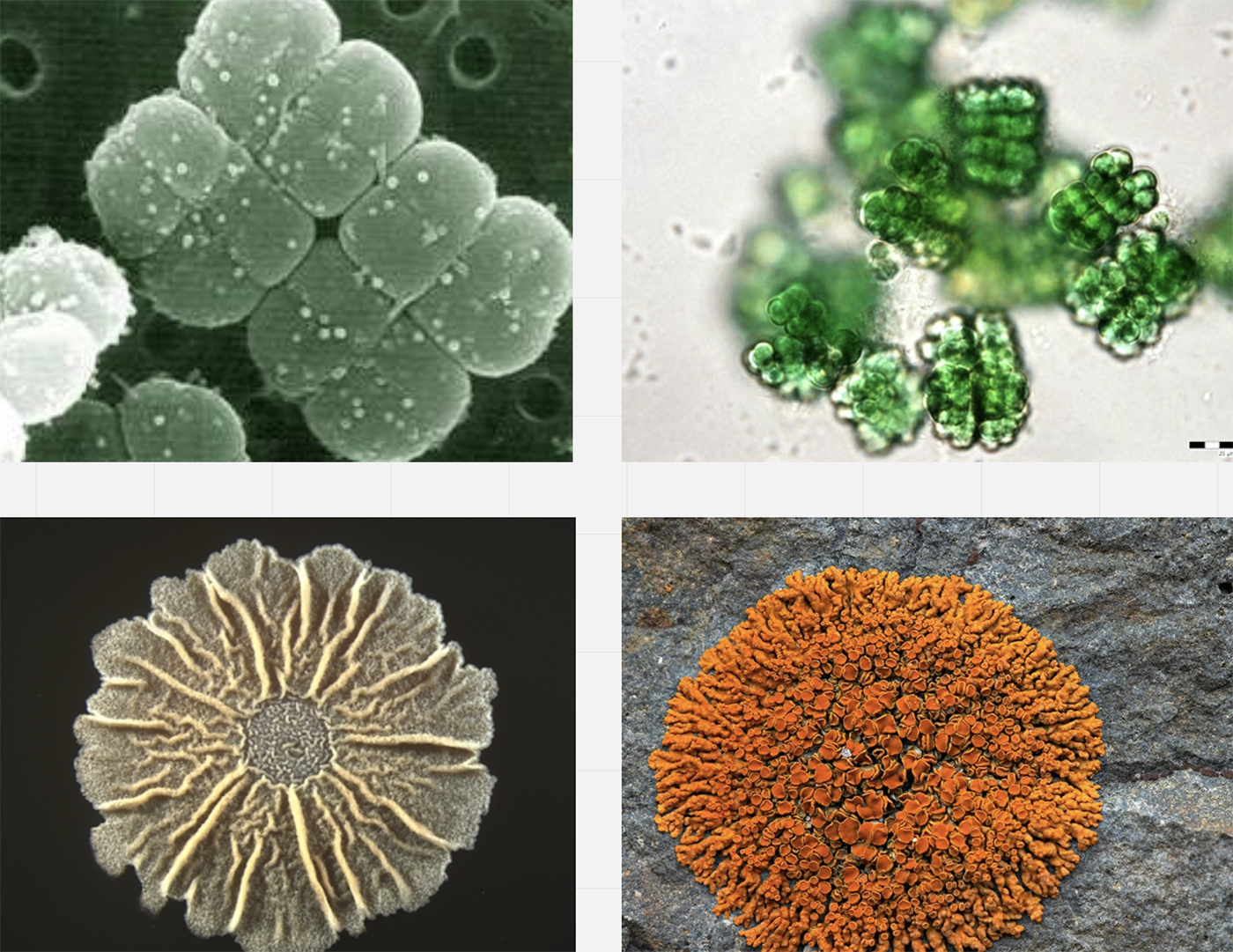
Chroococcidiopsis

Domain: Bacteria
Phylum: Cyanobacteria
Class: CyanophyceaeOrder: Chroococcidiopsidales
Classification: Bacteria
Strenght: extremely resistant to desiccation, UV-irradiation, salt toxicity and high and low temperature.
Oxygen production
Weakness:
Metabolim: Photosyntesis

Acidity: Acid tolerant over the range between pH 3 and 7
Mechanisms:
protected against destruction from high-energy UV-light by pigments such as carotenoids and scytonemin.
resistance to desiccation: poikilohydrous behaviour (apidly reduce photosynthesis and respiration to a minimum upon drought)
Chrooccocidiopsis can protect itself against high UV doses by the formation and self-embedment into large amounts of slime. (heteropolysaccharides) It is also able to grow or survive in biofilms, as endosymbiont in lichens, and living within rocks.
Links to images, video and other sources
The BOSS and BIOMEX space experiments on the EXPOSE-R2 mission: Endurance of the desert cyanobacterium Chroococcidiopsis under simulated space vacuum, Martian atmosphere, UVC radiation and temperature extremes https://doi.org/10.1016/j.actaastro.2013.05.015
Billi, D. (2020). Challenging the Survival Thresholds of a Desert Cyanobacterium under Laboratory Simulated and Space Conditions. Extremophiles as Astrobiological Models, 183–195. doi:10.1002/9781119593096.ch8
sci-hub.do/10.1002/9781119593096.ch8
The Cyanobacterium Chroococcidiopsis and Its Potential for Life on Mars https://www.researchgate.net/publication/340966132_The_Cyanobacterium_Chroococcidiopsis_and_Its_Potential_for_Life_on_Mars
(PDF) The Cyanobacterium Chroococcidiopsis and Its Potential for Life on Mars. Available from: https://www.researchgate.net/publication/340966132_The_Cyanobacterium_Chroococcidiopsis_and_Its_Potential_for_Life_on_Mars [accessed May 19 2021].

Deinococcus radiodurans
Polyextremophile
Domain: Bacteria
Phylum: Deinococcus-Thermus
Class: Deinococci
Order: Deinococcales
Non-sporulating bacterium
Links to images, video and other sources
Slade D, Radman M. Oxidative stress resistance in Deinococcus radiodurans. Microbiol Mol Biol R. 2011;75(1):133–91.
Potts M. Desiccation tolerance of prokaryotes. Microbiol Rev. 1994;58(4):755–805.
Krisko A, Radman M. Biology of extreme radiation resistance: the way of Deinococcus radiodurans. CSH Perspect Biol. 2013;5(7).
Classification: Bacteria
Strenght: extremely resistant to ionizing radiation, ultraviolet light, desiccation, and oxidizing and electrophilic agents.
Weakness:
Metabolim: Sugars can be used as a carbon and energy source, which in turn can be utilized by various repair mechanisms, for instance, the repair of damaged nucleic acids.
Radiation: An acute dose of 5,000 grays (Gy), or 500,000 rad, of ionizing radiation.
Mechanisms:
Deinococcus radiodurans also has a unique ability to repair damaged DNA. It isolates the damaged segments in a controlled area and repairs it. These bacteria can also repair many small fragments from an entire chromosome.
Nucleotide excision repair: It consists of four crucial proteins, UvrA, UvrB, UvrC and UvrD, which in conjunction with each other orchestrate effective DNA repair performance.
Resistance against radiation and oxidative damage is based on the high levels of constitutively expressed catalase and superoxide dismutase activity [50]. These enzymatic systems are devoted to the protection of cells against toxic reactive oxygen species.
Bacillus subtilis
Resistance as spore and biofilm

Domain: Bacteria
Phylum: Firmicutes
Class: BacilliOrder: Bacillales
Classification: Bacteria
Strenght: Proteinacicuos coat and geneting repairing.
Weakness: UV radiation
Metabolim: sugars or organic acids as sources of carbon and energy.
Mechanisms:
Damage prevention
- Slimes to protect from UV radiation
- Melanin like pigments that absorb UV radiation
- Proteinaicuous coat
Damage repair
- Genetic repairing
- NER Nucleotide excision repair
- SP repair by spore photoproduct lyase
Xanthoria elegans
Radiation and vacuum-resistant

Domain: Fungi
Division: Ascomycota
Class: Peltigerales
Order: Teloschistales
Classification: Fungi-Lichen
Radiation: UV radiation at wavelengths less than 160 nm or greater than 400 nm.
Mechanisms: ascospores inside the ascocarps are well protected by the anatomical structure, the gelatinous layer and the pigments (parietin and carotene)
Links to images, video and other sources
Halobacterium salinarum
UV resistance

Domain: Archaea
Phylum: Euryarchaeota
Class: HalobacteriaOrder: Halobacteriales
Classification: Archaea
Strenght: a sophisticated DNA repair mechanism
Mechanisms:
intracellular salts provide protection against ionizing radiation
Links to images, video and other sources
Kish A., Kirkali G., Robinson C., Rosenblatt R., Jaruga P., Dizdaroglu M., DiRuggiero J. Salt shields: Intracellular salts provide cellular protection against ionizing radiation in the halophilic archaeon, Halobacterium salinarum NRC-1. Environ. Microbiol. 2009;11:1066–1078. doi: 10.1111/j.1462-2920.2008.01828.x
Kottemann M, Kish A, Iloanusi C, Bjork S, DiRuggiero. Physiological responses of the halophilic archaeon Halobacterium sp. strain NRC1 to desiccation and gamma irradiation. JExtremophiles. 2005 Jun; 9(3):219-27.
Baliga NS, Bjork SJ, Bonneau R, Pan M, Iloanusi C, Kottemann MC, Hood L, DiRuggiero J. Systems level insights into the stress response to UV radiation in the halophilic archaeon Halobacterium NRC-1. Genome Res. 2004 Jun; 14(6):1025-35.
